CLOSED · WON · 2018 · age 18 · file 02 of seven · sales case
The deal file: one Facebook post, one ₹6 Cr flat, three franchises
A realtor posted in a Bangalore Facebook group looking for digital marketing. I cold-messaged
him, followed up for two weeks, got the meeting, then ran the work: strategy, content, campaigns.
I was eighteen.
₹6 Crone flat, his highest ticketa flat at Kesaku, Rajajinagar, and the buyer came through the campaign and the video we shot for it
14days before he repliedtwo weeks of follow-up, same ask every time, a different reason to say yes
3Raine & Horne franchisesthe first won cold, two more handed us their marketing with no outreach
Timeline2018 · Rewopme's first yearStatusClosed, wonTeam
MeGARECEOChannels
Facebook groupsMessenger · WhatsAppInstagramIn person
Problem
A realtor in Rajajinagar asked a Bangalore Facebook group to put him in touch with someone for digital marketing. Forty people commented tagging their friends. I didn't comment. I messaged him directly, that hour.
What I did
Messaged him within the hour, followed up for two weeks, ran the meeting alone and won it in the room. Then the work: listing-first social, one video and one campaign per flat, reported like a partner.
Result
A ₹6 Cr flat at Kesaku, Rajajinagar, his highest-ticket sale, with the buyer coming through our campaign. One Raine & Horne franchise became three, and I learned the brand from its India CEO.
Raine & Horne · Bangalore
CLOSED · WON
Lead card
Source
Facebook group, Put Me In Touch With Bangalore
Who
A realtor, Rajajinagar
Asked for
“someone for digital marketing”
Warmth
Cold. Never heard of us.
Me
18, first year of the agency
he wasn't looking for an agency. he was looking for help. same thing, if you show up.
Follow-up log
Day 0Saw the post. Messaged within the hour.
Week 1No reply. Followed up. Followed up again.
Week 2Still following up. Changed the angle, not the ask.
Day 14He replied. ✓ meeting
AfterRetainer. Then the ₹6 Cr listing.
LaterTwo more franchises. Three, total.
The log is reconstructed from memory. 2018 was a different phone. The Instagram receipts are further down ↓
01 Before this: the gate
Before the Facebook post, there was a gate
A year earlier, at seventeen, Ganesh and I had our first clients, and we got them the least
scalable way possible. We walked up to the security gates of gated communities and asked to pitch
the residents' association on a summer camp for the kids: art and dance for them,
Zumba for their mothers.
Most gates said no. Four said yes: two apartment complexes, two housing societies. We ran
the camps ourselves. That was the whole business plan: pitch a stranger face to face, get
told no, go to the next gate. By the time I was doing it over Messenger, the fear was gone.
Apartment 01summer camp · kids' art & danceyes
Apartment 02summer camp · Zumba for the ladiesyes
Society 01pitched the association, ran it ourselvesyes
Society 02the fourth yes, many more no'syes
age 17. two founders. zero funnel. four gates.
02 The post
Forty people tagged a friend. I messaged him directly.
2018. Rewopme Media was a few months old and I was eighteen. I spent my evenings in Bangalore
Facebook groups. Not posting, reading. Put Me In Touch With Bangalore is
exactly what it sounds like: people asking to be connected to someone who can do a thing.
A realtor in Rajajinagar asked to be put in touch with someone for digital marketing. Forty
people commented tagging their friends. I didn't comment. I messaged him directly, that
hour, with what I'd do for his listings and why. Not who we were, because we weren't anyone yet.
The lesson I still use: the best lead is someone who has already said what they want, in
public. Prospecting is guessing. Listening is cheaper.
03 Two weeks
Two weeks of not being ignored
He didn't reply. Not on day one, not on day four. Every few days I sent something new: a listing
of his I'd found and how I'd shoot it, a realtor in another city doing it well, a shorter version of
the first message in case the first one was the problem. Same ask every time. Different
reason to say yes.
|||| |||| ✎Follow-ups: lost count. Two weeks, no reply, no anger. He wasn't ignoring me. He was busy selling flats.
On day fourteen he replied with a time and an address. The meeting was in his office, in person,
and I went alone. He said yes in the room. Not because the pitch was brilliant. Because I was
the only one still there.
04 The ₹6 Cr flat
One listing, shot properly, brought the buyer
We took over his social presence, Instagram and Facebook, and rebuilt it around individual
listings instead of “contact us for best deals”. Each flat got its own treatment: shot properly, cut
into content, put in front of the right Bangalore audience with real money behind it.
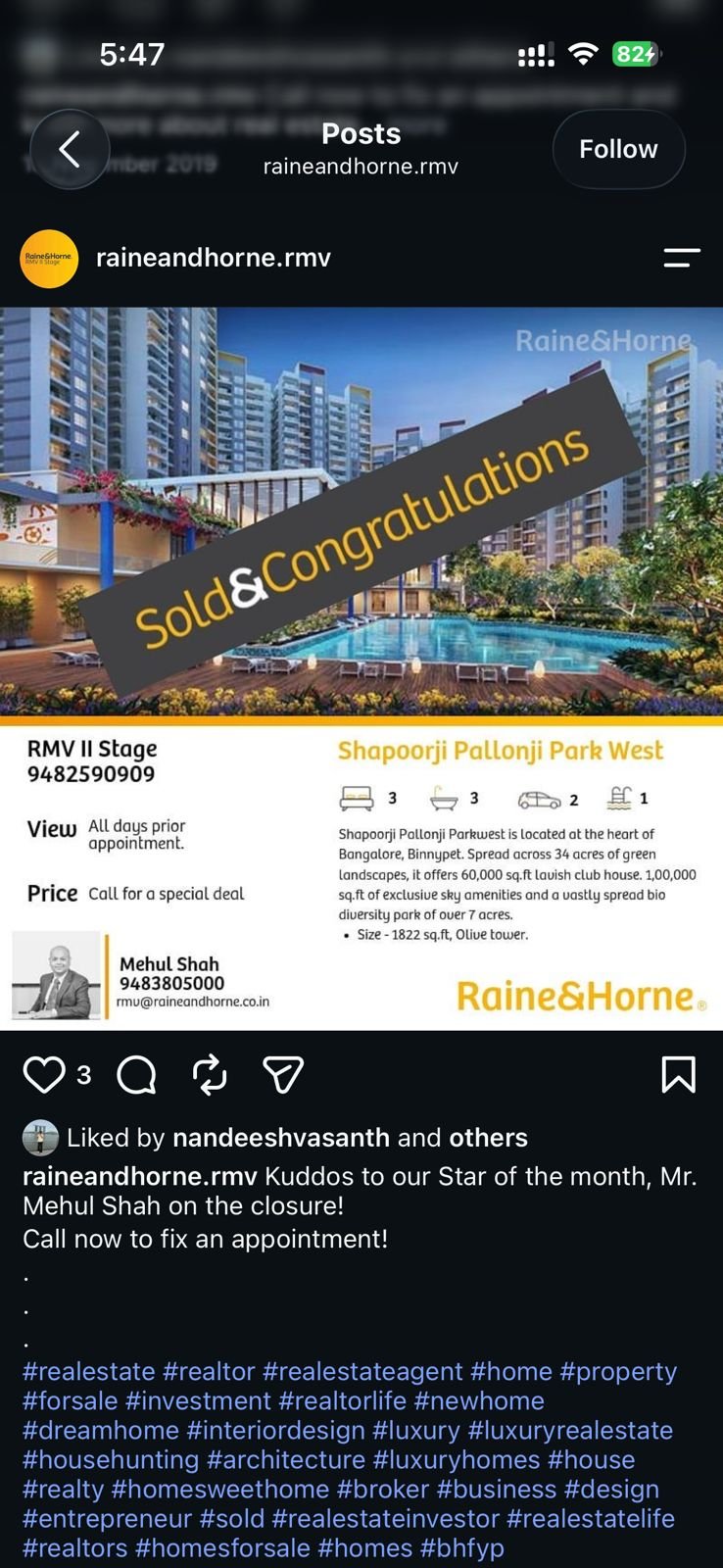
One of those listings was a flat at Kesaku, Rajajinagar. It sold for
₹6 crore, the highest-ticket sale he'd ever closed, and the buyer came through
the online campaign and the video assets we created for that flat. Not brand presence around a
sale that would have happened anyway: the lead itself. He was clear about that, which is how an
eighteen-year-old ends up with a story like this one.
What we actually did
Listing-first social, with a budget behind each flat
One listing, one campaign
Video shot and edited per property, then promoted. High-ticket flats don't sell off a carousel of ten.
Audience over reach
Paid distribution aimed at the buyers who could actually afford Rajajinagar, not at follower counts.
Realtor as the face
Built his personal presence alongside the listings. Buyers trust a person before a logo.
Reported like a partner
What went out, what it cost, who called. He always knew what the money did.
05 Raine & Horne
Carrying an Australian brand into Bangalore
The twist I hadn't seen coming: he had just bought a franchise of Raine & Horne,
an Australian real-estate brand with a century of positioning behind it. Which meant the account
wasn't “a realtor's Instagram” anymore. It was a global brand's first impression on a city.
So we worked closely with Raine & Horne's India CEO: the brand guidelines, the
tone, what the brand promises and what it never says. Then the harder part: carrying all of that
into the Bangalore market, in the language of Rajajinagar buyers, without the brand feeling imported.
Received from the India CEOThe brand as written
Guidelines, positioning, a century of trust. All built for a very different market.
→translated, not copied
What we shippedThe brand as Bangalore saw it
The same promise, localised for Rajajinagar buyers, and approved by the people who own it.
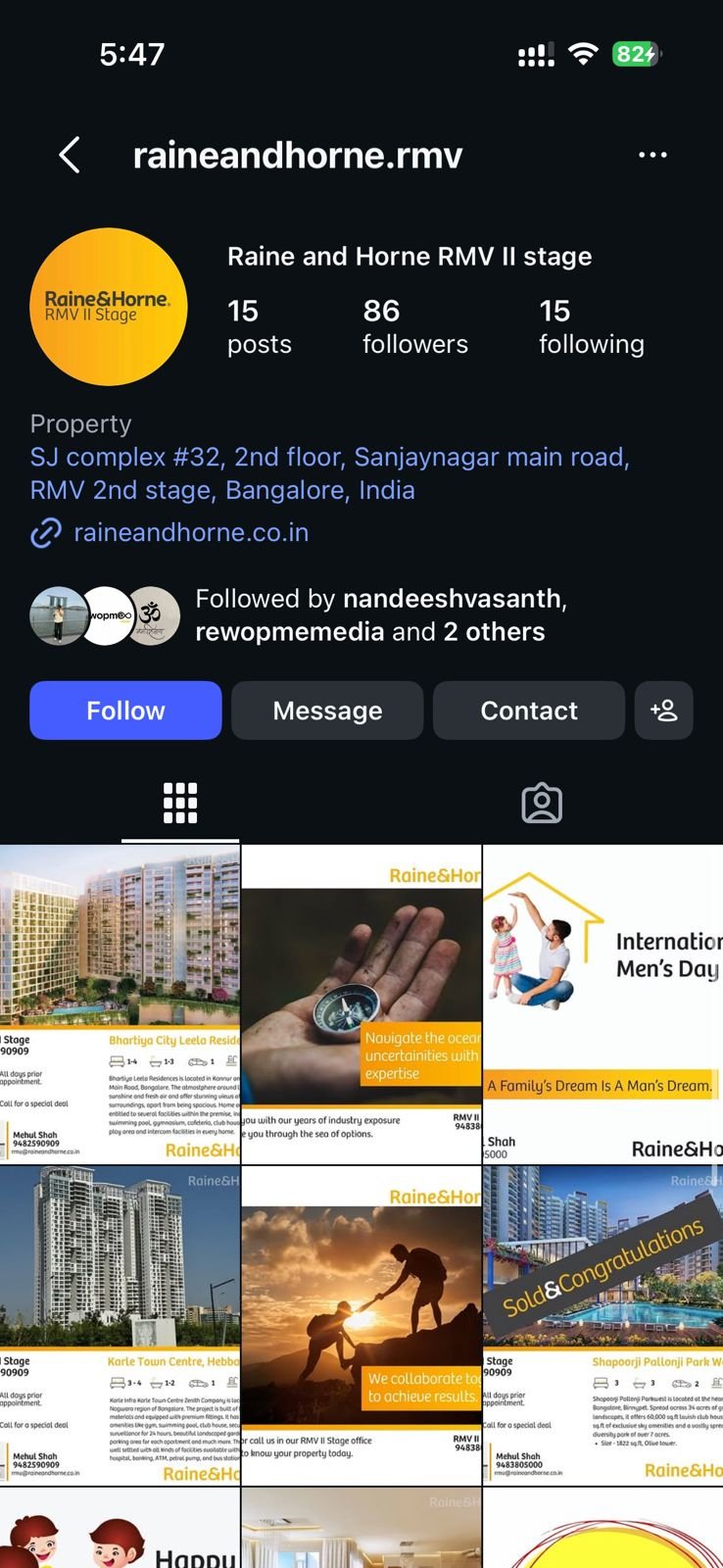
Still up: the RMV II Stage franchise's Instagram, one of the two accounts that followed Rajajinagar. Listing cards alternating with brand posts, every one on the same yellow band and lockup. Look at who's in the followers: rewopmemedia.
I was eighteen and learning brand stewardship from the person accountable for a national franchise.
That's the part of this story I'd put on a résumé before the ₹6 Cr.
06 One → three
One franchise became three
The work got noticed inside the network. Two more Raine & Horne franchises in Bangalore handed
us their marketing. No outreach this time. The first account did the selling.
RajajinagarThe cold one. Two weeks of follow-up, a meeting, a ₹6 Cr flat.
RMV II StageCame through the network on the strength of 01. No pitch. Its Instagram is still up. See above.
Bangalore, thirdSame. Three franchises, one brand, one eighteen-year-old's agency.
the follow-up is the job. the pitch is just the excuse.
07 What it taught me
What the file taught me
Nobody is ignoring you. They're busy. Follow up like you believe that.
Two weeks of unanswered messages is not rejection. It's a calendar problem, and it's the whole moat, because almost everyone stops at message two.
Listen where intent is already public. Facebook groups then; founder communities, job posts and Reddit threads now. Same move.
Sell the work, not the agency. We had no logo worth showing. The first message was about his listings, and that was enough.
The first account is the sales team for the next two. Franchises 02 and 03 needed no pitch, just 01 done well.
Carrying someone else's brand faithfully is a skill. Learning it from an India CEO at eighteen is why I'm comfortable representing a founder's voice now.
Eight years on, this is still the loop: find the person who has said what they need, show up
more times than is comfortable, do the work so well it sells the next one. That's most of what
building anything asks of you, and it's the part I've done since I had to ask a security guard to
let me in.